Published on
Over the past forty eight hours, India has been in a state of turmoil, but one that is tinged with hope. The collective uprising of hundreds and thousands, starting in New Delhi and spreading to other cities across the nation, triggered by infuriated students and an apathetic state, has snowballed into something that feels larger. When one side holds up the Constitution and books while the other carries lathis and tear gas, when children and women are attacked for demanding accountability, something must shift.
Education reform and corruption might be the spark, but this is about gradually building resentment, about a government that has been divisive and authoritarian for too long, and about many issues, social, economic and political, that have most affected the youth. The list is far too long to recount here, but there’s no better way to show our support for the students than by recommending some brilliant Indian books which feel relevant to the current moment.
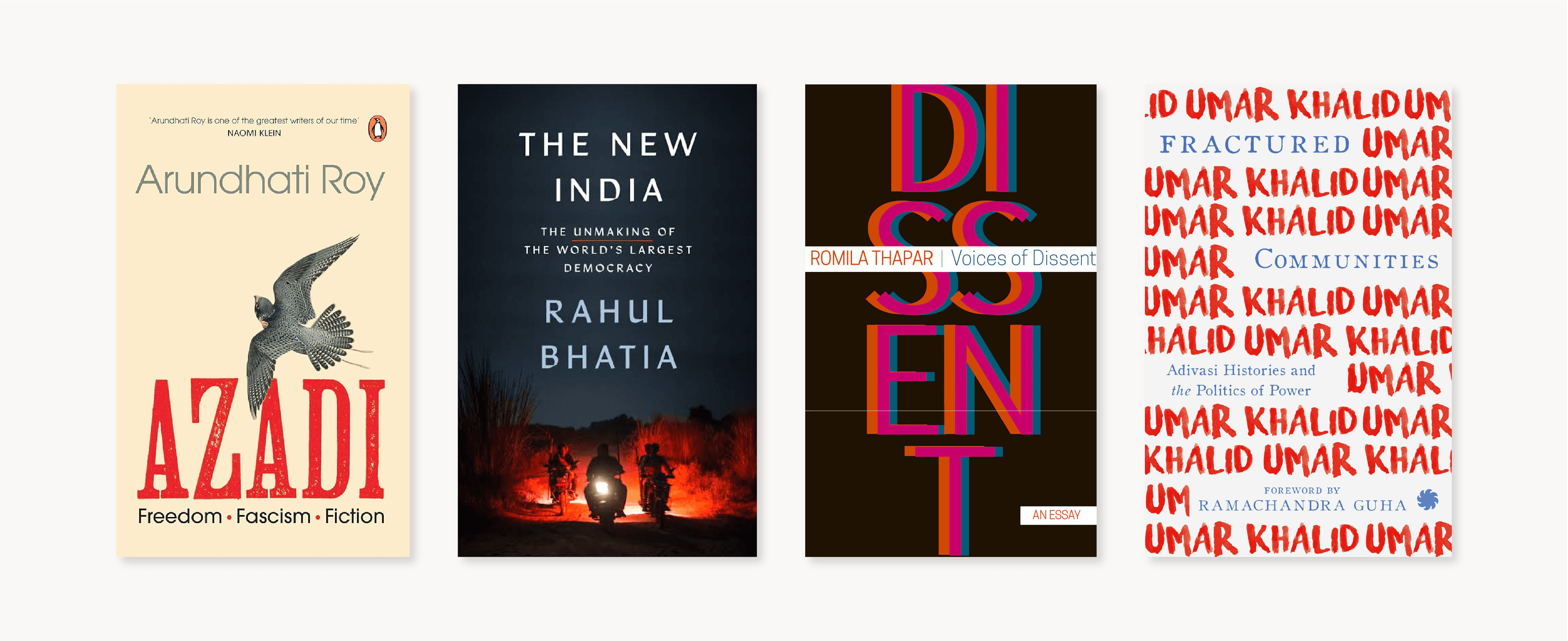
Arundhati Roy – Azadi
Subtitled ‘Freedom, Fascism, Fiction’, where else to begin than with a collection of Arundhati Roy’s powerful essays? Varied, thoughtful and intelligent, the book includes meditations on language, public as well as private, and on the role of fiction and alternative imaginations in these disturbing times. Drawing upon her own work reporting and supporting various activist movements, Roy challenges us to reflect on the meaning of freedom in a world of growing authoritarianism, particularly in the Indian context.
Rahul Bhatia – The New India
The New India (titled The Identity Project in India) is a book of narrative reportage about the road to authoritarianism in India and its effects on citizens.Using hundreds of interviews, letters, diary entries, Partition-era police reports, and a range of sources, journalist Rahul Bhatia shows how history plays a recurring role in the present: in politics, in the minds of citizens, in notions of justice and corruption. From nineteenth-century secret societies to the rise of Hindu nationalism to the Delhi riots of 2020 to the way misinformation and religious division has been weaponised by the current regime, this is an essential work of nonfiction.
Romila Thapar – Voices of Dissent
In Voices of Dissent: An Essay, one of India’s foremost historians looks at the articulation of nonviolent dissent and relates it to various pivotal moments throughout India’s history. Beginning with Vedic times to the views of Bhakti saints and others of the fifteenth and sixteenth centuries to Gandhi’s satyagraha to our current time, Thapar contextualises the history of dissent. Rigorously observed, her work maintains that dissent in our time must be opposed to injustice and supportive of democratic rights, so that society may change for the better.
Umar Khalid – Fractured Communities
Before being arguably India’s best known political prisoner, and being detained for many years facing sedition charges, Umar Khalid completed his PhD thesis on the history of the Adivasi tribes of the Singhbhum region of Jharkhand under extraordinary circumstances. Fractured Communities is the culmination of this thesis, written under challenging circumstances and praised by scholars and historians including Ramachandra Guha and Nandini Sundar. Khalid combines archival rigour with analytical clarity to illuminate the history of Singhbhum’s tribal societies under British rule. The book is both a valuable work of history and a critique of histories written from positions of power.
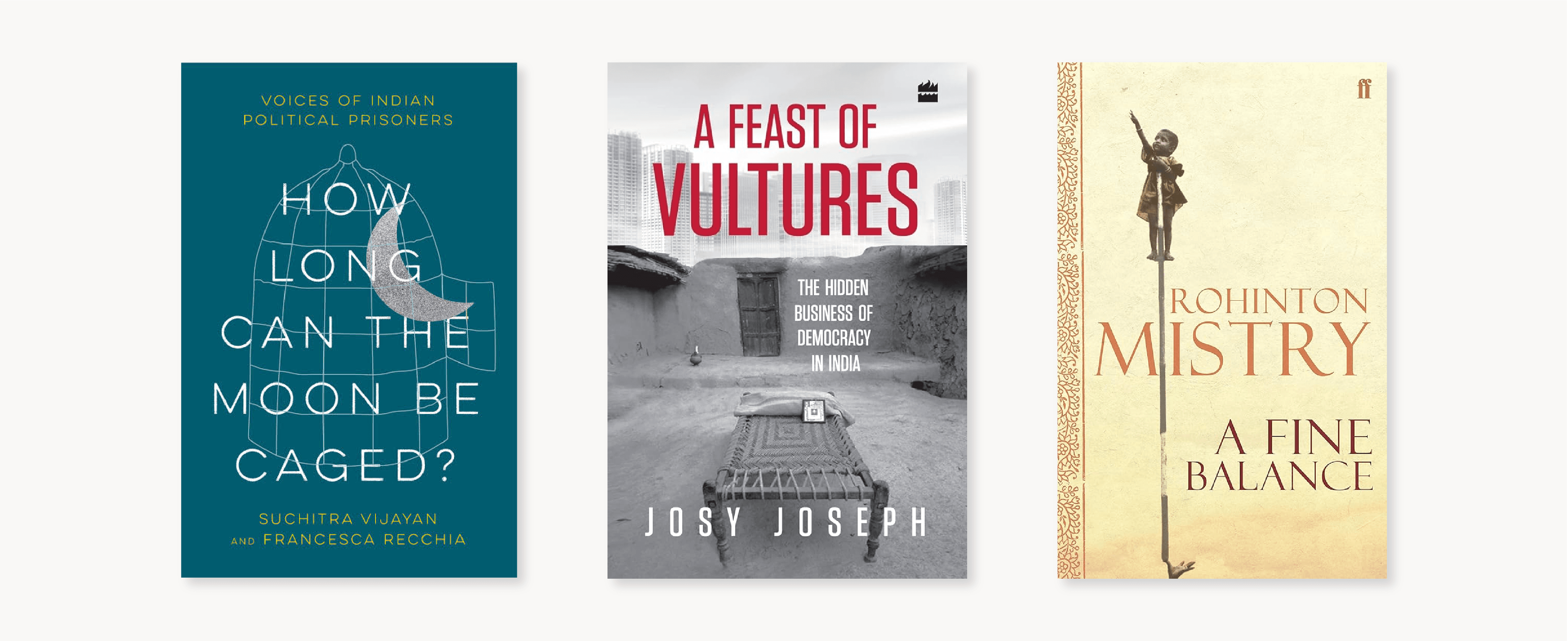
Suchitra Vijayan and Francesca Recchia – How Long Can The Moon Be Caged?
In this unique book, Vijayan and Recchia look at the present of India through the lived experiences of political prisoners. Combining political and legal analysis with firsthand testimonies, the book explores the small gestures that constitute resistance inside and outside jail for the prisoners and their families, telling a story of the destruction of institutions and erosion of rights. Bringing together the voices of activists, prisoners and academics, the book celebrates the courage, humanity and moral integrity of those jailed for standing in solidarity with the marginalised or falsely accused by the regime.
Josy Joseph – A Feast of Vultures
One of India’s best known investigative journalists, Joseph draws upon his experiences to delve into treacherous business rivalries, the shadowy men who run the nation's politics and the nexus between industry and government. A Feast of Vultures is an unprecedented, multiple-level inquiry into modern India, and the picture it reveals is both explosive and frightening. Through hard-nosed investigations and the meticulous gathering of documentary evidence, Joseph examines and documents the state of a nation while raising uncomfortable and important questions.
Rohinton Mistry – A Fine Balance
We had to include a novel, and what better one to recommend than A Fine Balance? The parallels to our time of undeclared emergency are uncanny. The time is 1975. The place is an unnamed city by the sea, and following the declaration of a State of Emergency, four strangers – a spirited widow, a young student, and two tailors who have fled caste violence – are thrust together, forced to share one cramped apartment and an uncertain future. A modern classic, Mistry’s novel creates an enduring panorama of the human spirit in an inhuman state.
Share