Sohan Bhattacharya
Published on
Translated from Marathi by Uma Shirodkar
Translator’s Note:
Written in 1977, Kaaksparsha (literally: Touch of the Crow) is a harrowing portrayal of the invisible horrors of widowhood. This story is set in Konkan, a region in coastal Maharashtra, in the 1930s. The title derives from the kaaksparsha— the thirteenth- day Hindu funeral rite where a deceased soul is considered liberated only if crows peck at an offering of cooked rice. Within this text, it also alludes to the superstition that the touch of a crow is inauspicious, while paradoxically also awakening suppressed sexual desires in women. It also exposes the hypocrisy of rituals and patriarchy.
I was struck by this story’s simultaneous simplicity and depth, and sensitively handled themes. As a translator, I had a dual challenge: firstly, to recreate Datar’s restrained yet evocative prose with its quaint yet impactful language and liberal subtext; and secondly, to retain its cultural nuances. My namesake Uma, Tara-vahini, Haridada and the rest of this family have stayed with me for many months. They now feel like people I have known intimately. Perhaps that’s precisely what Datar intended for her readers— to feel as she did: ‘The characters in my stories talk to me and share their joys and sorrows; and that’s why I’m never alone’.I hope these characters have spoken to you as they have to me.
*
Durga’s father peered outside, gauging the shifting shadows. Relatives kept milling in and out of the baithak. Weary eyes glanced repeatedly towards the gate. The guests from Torgaon ought to have arrived by now!
Just then, a resounding krrr-krrr echoed from the street. The distant squeaking of footwear multiplied. Gold uparne hems gleamed in the sun. A few relatives hurriedly unlatched the gate. Wearing a topi, Durga’s father came forward to receive the guests. The family rose gracefully in greeting.
A gleaming brass urn full of water stood ready near the courtyard. The guests washed their feet and came in. The few women among them turned towards the maajghar, the central room of the house, from the back door.
Everyone settled down. The baithak was finally at ease. The cynosure of all eyes was Haridada—who sat in the centre, leaning against a bolster. His chequered red and gold turban stood out, as did his towering, commandeering presence. The scene looked as charming as a new bride wearing red kunkoo.
To Haridada’s left sat the upadhyay— the priest— and next to him his brother-in-law and the marriage negotiator. The groom Mahadev— Haridada’s younger brother, studying to be a barrister in Mumbai — had also been brought along, in a break from tradition. The family had hatched a plan during the Diwali break in order to meet potential brides.
Mahadev grumbled under his breath. It was the crucial final year of B.A.—he had to study for his examinations. He had begrudgingly shown up for Bhaubeej at his sister Anu-tai’s home, and had then planned to hurry back to Mumbai.
But Haridada was the responsible one. After their parents died, he was the one who had raised his younger siblings like a loving mother. Once he took charge, the job was as good as done. No one else needed to be involved.
Durga’s family solemnly took their seats. A platter of supari and a nutcracker was quickly set down. The children brought lotas, glasses, and little plates piled with jaggery.
There was a flash of bright saffron— the tie-dyed border of a saree— on the threshold. Impulsively, everyone fell silent. As Durga stepped into the baithak, her soles seemed to trail filigreed vermillion across the ground. She came and stood against a wall, poised yet demure— just like the goddess Rukmini, with a wedding garland at her own swayamvar.
The girl folded her dainty lotus-bud palms and bent to take Haridada’s blessing. In his mind he had already granted his consent; flooded with adulation at his darling brother’s good fortune.
‘My dear girl, Durga is another name for…...?’
‘Parvati!’ she answered.
Her voice tinkled like a pali spoon striking a sacred panchapatri salver, soft, pure and melodious. The answer pleased Haridada. The goddess Parvati had herself appeared for Mahadev. An auspicious omen! A match made in heaven!
Durga was rewarded with sweet pedhas. Haridada’s wife Tara-vahini applied kunkoo and gifted her a customary khunn, the fabric folded into a triangle.
The Torgaon guests left. As they crossed the gate and spilled onto the main road, chatter suddenly broke out amongst Durga’s siblings.
‘Ago, did you get a chance to look at the groom? There, he’s wearing a Mumbai coat and topi—’
‘Ago, not there! At the back, the one in the blue coat…. look there! Where are you looking?’
Truth be told, Durga hadn’t even noticed him, not even fleetingly. Firstly, a bashful Mahadev had shrunk into a corner, while an equally mortified Durga sat frozen; a stiff neck didn’t let her take even a peek. Haridada’s commandeering presence was firmly imprinted onto her impressionable mind instead; his imposing frame crowned with the red checked turban—his voice clear, powerful and resonant.
‘But he was secretly looking at you, you know!’
*
‘Rascal! He was secretly staring at Durga!’
Mahadev sheepishly looked away. He wasn’t used to Haridada’s unexpected teasing. Even Haridada’s moustache was so animated that it gave off a feeling of being astonished. It was all Durga’s magic— just one glimpse of the girl in her wholesome glory!
‘Arrey, we couldn’t take our eyes off her either! Why blame him? Mahadev, we won’t be able to have the wedding in the month of Kartik. Will you wait until Margashirsha? Lucky fellow, Dada’s taken good care of you, always had your back. And now you’re getting a bride fair as milk!’ Anu-tai observed.
Haridada’s siblings saw a father in him; and on his part he made sure they never lacked for even the tiniest things. He had taken care of Anu-tai’s confinement, delivery and pre-birth ceremonies just like a mother would. Nothing was missed. And for his little brother, his affection was otherworldly. Unless Mahadev ate, Haridada would never even set aside a portion of food as chitrahuti, let alone begin his meal.
‘But Dada, I don’t plan to set up a new home so soon. I want to study for L.L.B first.’
‘Who’s saying no? Many of our lands are still languishing like wet quilts, growing heavier and more damp. You become a barrister first, these tenant farmers will all fall right in line.’
‘Then why get involved with something else?’
‘Arrey, what’s a blade of grass for a loaded cart? She’ll be just like Shanti and Kushi, a third addition.’ Anu-tai said, referring to her nieces. Is she going to be a burden? Wait…you like the girl, don’t you? Then say so.’
Mahadev had taken one look at Durga and fallen hard for her. That’s why he had unexpectedly agreed to get hitched. Outwardly, he feigned reluctance.
‘But Dada, holidays are getting over.’
‘So? Are we already chaining you to the wall? Just show up for the wedding.’
‘But I have to study!’
‘Don’t be silly. The Collectorate isn’t going to collapse in two days. Take the first boat out as soon as the feast and the kankan ceremony is over. No one’s stopping you!’
‘Anu-vansa, you have to come at least a month before—to help out,’ declared Tara-vahini.
‘Ago, of course I’ll come, but is there a dearth of people for Dada? The entire village is with him. If he calls, they’ll leave their beds even at midnight!’
‘Shastri-buva, finalise the muhurta. We need to inform the bride’s family. They have more work there!’ instructed Haridada.
‘Dashami, tenth lunar day. Favourable moon position. And what about the consummation? Immediately after?’
‘Let’s see!’
*
For the zhaal ceremony, Haridada and Tara-vahini sat on wooden seats beside the newlyweds. Durga’s mother stood holding a green khunn. Her father passed a shiptar, a shallow bamboo basket filled with fruits and flowers and dough lamps over their heads. The lamps burned with a steady, unwavering flame. The chatty, celebratory air suddenly turned sombre. Haridada, ever dutiful, bowed his turbaned head.
The wedding palanquin crossed the village boundaries and entered Torgaon. Durga was fascinated with both her new home and new name as a wife. During the Lakshmi Pujan she was christened Uma, the unfamiliar word traced in rice grains on a salver.
The house was massive, built in the traditional chausopi style with four vast verandahs. But it still couldn’t contain the mish-mash of guests. Mahadev was all packed and ready to leave, even before the soop —a ritual signifying the end of the wedding ceremonies— could conclude. The family teased him relentlessly. Even Jaanu the farmhand joined in.
‘Why you taking everything? Won’t you return in fifteen days?’
‘Chhe re baba! Now nothing until the examinations get over!’
‘Bhavoji, leave as soon as we send a letter, got it?’ Tara-vahini said with a knowing grin, placing a pat of dahi into Mahadev’s palm.
Uma was swarmed by the wedding party. ‘Uma-kaku, Uma-kaku!’ chirped Kushi and Shanti, clinging tightly to their aunt’s arms.
‘What’s this ‘Uma-Uma’? Why don’t you just say ‘kaku’? Is there a bagful of kakus lying around?’ scolded Namu-aaji.
Namu-aaji was the eldest in the family. Only she had the authority to address Haridada informally as ‘Hari’. She was well-versed in familial rituals and customs. Adjusting the end of her crimson widow’s saree over her head, she trained her hawk gaze at the ground.
‘Her second toe is larger than her big one!’ she observed. ‘Good! Hari’s sister-in-law is a lucky girl!’
‘Namu-aaji, of all the things you noticed only her feet?’
Of course! If she’d only looked up…I’d have seen more than just a glimpse of her face. That’s fine. I have all my life for that.’
Uma was so mortified that she refused to turn around to see her husband off.
The wedding was over. Tara-vahini tied up all loose ends, taking stock of the goods. Everyone packed up their belongings. The crowd gradually thinned out. At long last, even Anu-tai gathered her sizeable brood and climbed into the bullock cart. Now only Haridada and his relatively small family remained.
The children clung to Uma so fervently that she felt herself thickening into gooseberry preserve. Shanti and Kushi clung to one side, and the twin boys Trivikram and Sankarshan to the other. They all made sure she paid attention to them. The girls wanted Uma to braid their hair; no one else passed muster. The boys demanded new bedtime stories every day.
Uma, ever the dutiful new wife, would linger around in the kitchen. But once the day’s work was done, Tara-vahini would lovingly yet firmly shepherd her out.
‘That’s enough, now go to sleep. Back home it would have been midnight. Enough for today.—You’ll be too exhausted by the time Bhavoji returns—’
In the maajghar, Kushi and Shanti would both wait for Uma to settle down between them.
Huddled underneath the covers, the three girls exchanged secrets in their own little world.
*
The family celebrated Uma’s first period. She sat on a decorated seat called a makhar. Along with Anu-tai’s daughter Chhabu, a mesmerised Kushi and Shanti settled down beside the makhar. They wouldn’t leave Uma’s side.
‘Aai, can I sit next to Kaku?’
‘You’re a woman. Once you’re older, you will!’
‘Aai, can Kaku braid my hair?’
‘Your nose will burst! Ago, she’s not supposed to touch you.’
‘Why not? Is she like a devi?’
‘Hmm. Watch the fun in a few days!’
The attention overwhelmed Uma underfoot. A steady stream of festive food poured in from the neighbours.
‘Ladies, make way! Here’s the food.’
‘Don’t serve too much, it doesn’t get over. Agobai, what’s this? Banana leaf again?’
‘They’ve sent it specially for her. Let’s see…. Puranpoli from the Ranades, botvyanchi kheer and kanavle from the Joshis next door–’
‘The children have been feasting for two days straight. Only for the vaishvadeva we kept some rice aside. The remaining we’ve been sending straight to Jaanu.’
Tara-vahini measured out some rice like she did every day.
‘Vahini, what’s this? Why so much?’
‘What do you mean? What if we fall short? Why depend on anyone?’
‘You’re respectable folk. What could you lack for?’
Just then, Haridada’s voice boomed from the maajghar.
‘Anu, look! Your brother’s acting smart!’
‘Is that a letter? What does he say? Is he grumbling about the examinations?’
‘Listen— to your brother-in-law’s pearls of wisdom!’ he said to Tara-vahini, reading aloud Mahadev’s letter. ‘I have to study. I have no time. Write to me only if you really need me!’
Uma choked on her food. A red-faced Tara-vahini and Anu-tai pulled their saree hems over their mouths.
‘Arrey, what did you tell him?’
‘I mentioned a pooja. I didn’t say anything about Uma. Otherwise, his friends would have teased him. Now see what the smartass says!’
‘Vahini, call Namu-aaji over,’ advised Anu-tai. ‘She knows things. She can help.’
Gifts arrived from Uma’s maternal family for the consummation: a silver cup and taambyaa, a mattress and pillow, a milk tumbler, a vial of attar and a gulabdaani to sprinkle rosewater; and a new pair of dhotars for the son-in-law. Everything was in place, except for Mahadev— the son-in-law himself. The family trained their ears towards the harbour, waiting for the foghorn to blare. The boat had not yet arrived.
Uma was bathed with ubtan and scented oil. Vahini dressed her in a new white saree marked with red kunkoo.
‘Uma’s-mother, you're the elder among us. After you.’ urged Tara-vahini, eager to start the oti ceremony.
‘Nothing doing, Tara-vahini. You’re family, after all!’
‘Why argue? Both of you, come. Anu, you too. And bring more women, we’re two short. Five women to match the five holy fruits.’
On cue, the two Ranade daughters-in-law appeared. One held a small plate covered with a banana leaf.
‘What’s this? Have you brought more food?’
‘Here, see!’
It was a chignon cover, woven with bright yellow shevanti blossoms. She fitted it over Uma’s voluminous bun updo.
‘I thought it would be loose, but it fits perfectly.’
‘Now bend so I can start the oti.’ said Tara-vahini.
Dada watched contentedly from the threshold, eyes brimming with affection.
Uma’s swept-up hair was still studded with leftover rice grains. Draped in sparkling ivory, she resembled a mound of steaming varan-bhaat consecrated with a golden dollop of pure ghee… a feast Mahadev was soon to savour.
The girls clapped excitedly out in the courtyard. Mahadev opened the gate and came in. Jaanu followed, hauling his bags.
The ritual fires had already been lit. But even after the smoke cleared, Mahadev’s eyes remained bloodshot like a kokum fruit.
‘What’s this? Do you stay up studying?’
‘Uh…. yes.
‘Then why do you look so tired?’
‘Hey, don’t nag him! He must be seasick from the journey. Uma, he’s getting restless….! Mahadev, go sit over there on that paat.’
Tara-vahini brought lukewarm water in a gadwa.
‘Uma, now wash his feet.’
The tiny room teemed with a crowd of people young and old. Half-dead with embarrassment, Uma lifted Mahadev’s foot. Anu-tai poured a thin stream of water onto it.
‘Tssss- haay!’ Uma flinched weakly.
‘What happened? The water’s not so hot!’
Mahadev’s feet were hot to the touch…not the water. Vahini held out a little plate of milk sweets. But Mahadev swayed sideways instead, slumped against the wall, and abruptly closed his eyes. His neck rolled to one side.
Namu-aaji hurried forward. ‘He’s burning up like a griddle!’
Haridada carefully lifted him up and laid him on the string cot in the verandah. The vaidya was summoned.
Uma leaned against the wall; her lips tightly pursed together in terror.
The bridal chamber waited silently in anticipation; the bedsheet remained pristine and unwrinkled. The nishigandha flowers drooped, heavy with despair. The thickened milk slowly congealed in its silver tumbler, untouched. A gust of wind scattered the swastikas of rangoli on the floor.
The flames on the samai waited and languished…. and then they flickered out.
*
Each time she laid eyes on the flickering lamp, a despondent Anu-tai dissolved into fresh tears.
‘Ago, enough, your eyes and nose will fall off!’ consoled Namu-aaji as she patted Anu-tai’s back and herself tried to stifle a sob. In the maajghar, Uma lay motionless. Tara-vahini had taken to her bed. Dada sat stony and grief -stricken.
The wedding sweets were not yet finished, and the groom’s funeral pyre had already turned cold. It was an unfathomable tragedy.
A veil of gloom shrouded Torgaon. Still, the community members made a mammoth effort, to try and shake a paralysed Dada out of his stupor.
The wilted shevanti languished in a dusty corner. Next to it, bundled in widow’s white, crouched Uma’s diminutive frame. Dada noticed, and was overcome with three realms worth of dread.
The upadhyay came, shoulders slumped in grief. He could not bring himself to utter mantras. Days ago, a wedding tent decorated with an arch of banana plants had stood in the courtyard. Today in its place, was a wake. It was heart-wrenching.
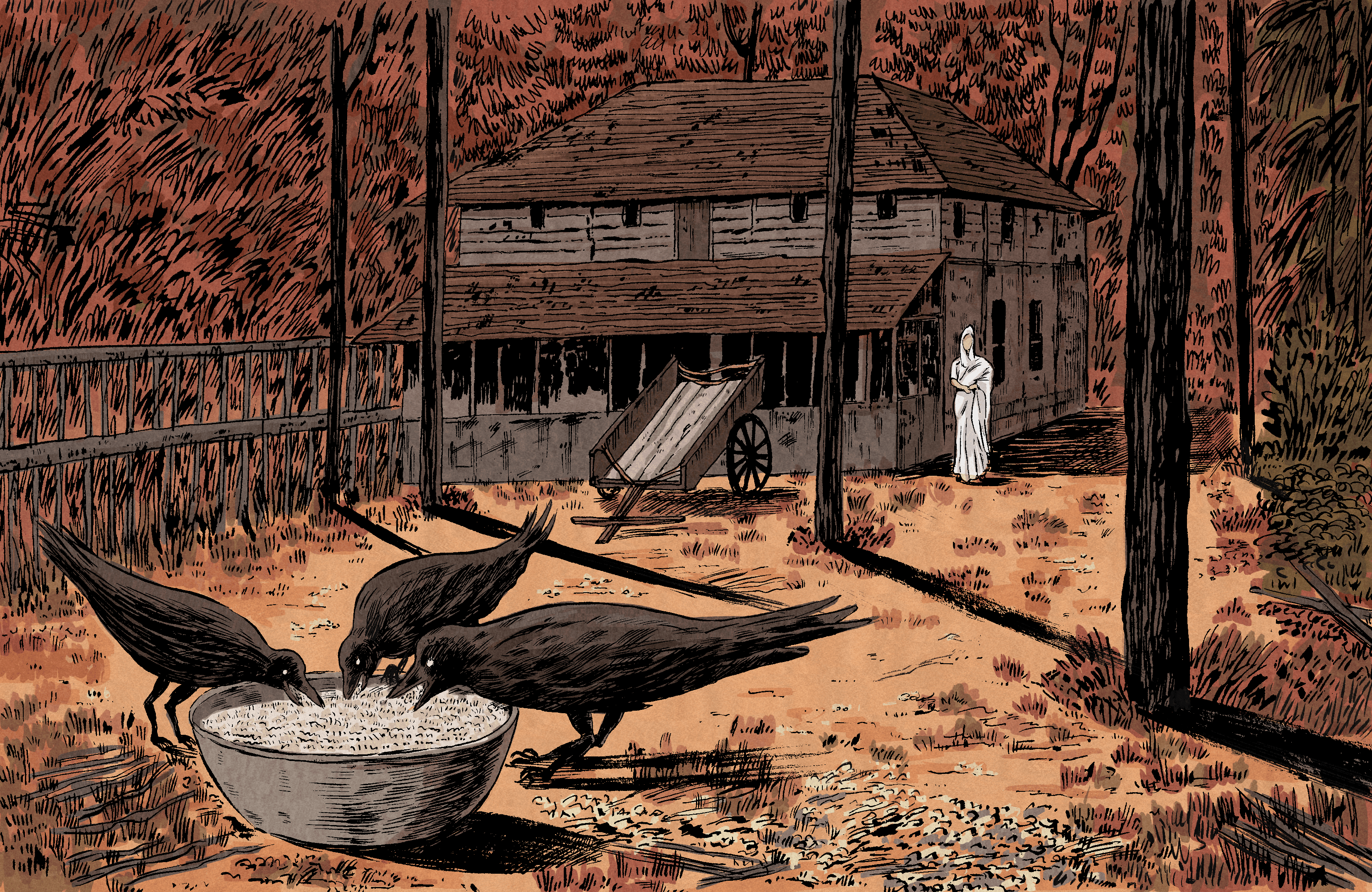
The pindas— the little heaps of cooked rice were ready, but the crows refused to descend to peck at them.
Dada watched the unholy sight, and darkness clouded his vision. A lovely saree-clad Uma on her wedding night like fresh varan-bhaat flashed before his eyes, and the world lurched. Weak and dizzy with grief, he shivered in his wet panchaa. He felt his knees buckling.
Hidden terrified in the trees, the crows refused to come. The departed soul would have to be persuaded somehow.
Dada clutched his aching head in his hands and shut his eyes tight. Only his lips moved. He was too weak to speak in fully formed words.
Suddenly a flock of crows flew out and pecked at the rice. The kaaksparsha happened. What a miracle! A few stars still twinkled hopefully in a sorrow-filled sky. It was the end of an era. All was well. The villagers returned home.
The soul had been set free.
*
Uma had once entered Torgaon in a bridal palanquin. Today, she lay quietly in the dark, in the maajghar. Her belly spasmed with fear.
Her father was here; he wanted to take her back. Hesitantly he broached the topic with Dada. The thought of returning to her parents in that unfortunate, wretched state turned her mouth sour.
A firm voice carried in.
‘What do you mean? Does rain ever return to the sky?’
‘Sorry, Dada. Circumstances compelled me.’
‘So, what do you propose?’
‘Maybe we’ll send Durga back to school. There are charitable trusts nowadays.’
‘What for?’
‘To stand on her own feet.’
‘For food and shelter, you mean—She lacks none of that here. She’s as much the lady of the house as my wife. Not some destitute!’
Dada’s voice rose dangerously. The disconcerted relatives remained silent.
Tara-vahini found it odd too. Timidly she brought up the topic at night when they were alone.
‘Why so stubborn? You should have let them take her back. One thing off our heads!’
‘How can we just abandon her?’
‘She’s still so young. Only sixteen…how do we shoulder this lifelong responsibility?’
‘Why? We still do the vaishvadeva, don’t we? Those few morsels are enough for her.’
Dada displayed a streak of unhinged madness. Without another word, a baffled Vahini pulled the wick behind to extinguish the samai.
*
Nurtured by Vahini’s love and affection, Uma slowly recovered. Life came back to her. In Kushi and Shanti’s embraces, she momentarily forgot the loss of her husband. Her cheeks bloomed healthy with laughter, warmed with Sankarshan and Trivikram’s unfeigned love. Uma had never known marital bliss, but at least the shadow of grief began to lift.
For Uma, the house was like her own mother’s home. Like the other children, Tara-vahini took care of her, plied her too with milk and ghee, ensuring she ate well. Uma taught the girls songs and ovis. She selected tunics and topis for the boys, and kept their slates polished with charcoal.
One day Namu-aaji hobbled into the courtyard, straightening the crimson saree on her head out of habit. Uma gulped uneasily. It was as ominous as a black crow landing out of nowhere, on a pile of neatly drying papads.
‘Hari, I mean…what about ‘her’? Rules say we should have done it a long…...’
‘What ‘rules’, Namu-tai? We’re following all the rules!’
‘No, I mean as tradition dict— …’
Indoors, Uma quaked in terror. Her throat went dry and her tongue twisted speechless. She wished the neighbouring storeroom would swallow her whole. One more thing to add to her already heavy burden of sorrows—
Suddenly Dada—in a stiff, unyielding tone—replied,
‘I’m well aware of these ‘rituals’—You don’t need to teach me!’
‘But what about the priests…’
‘Leave it to me. If push comes to shove, I’m capable of doing it myself!’
‘But how is this okay? God will curse us if….’
Namu-aaji’s tone mellowed. But Dada was still adamant.
‘It jolly well be okay! And to hell with God. What about us? We put up meekly with his whims, didn’t we? This ends here—dare you bring up the matter again.’
Namu-aaji turned to leave, her pride wounded.
Mopping her sweaty brow, Uma exhaled. The grim possibility of a widow’s shorn head seemed unlikely for now. The blood rushed back to her numb legs and she felt as light as a feather.
‘Let her come for a few days at least!’ wheedled Uma’s father.
‘No need. This is her home.’
‘Her mother insists.’
‘No. Visit your daughter here, if you must.’
Uma’s folks left, frowning and fuming at Dada’s obstinacy. Vahini couldn’t fathom this wilful behaviour.
‘You should have let her go home, get some rest!’
‘Why? Have we yoked her to the oil press?’
‘Even sour mangoes taste sweet in a woman’s maternal home.’
‘Then get her some here. You’ll feed your two daughters later on, won’t you? Just like them, she’s a third.’
Vahini tactfully changed the topic.
Uma had no love left anymore for her maternal family. She had firmly rooted herself like a stone pillar into the foundations of her husband’s house– but the soil would never bear fruit. Hearts ached collectively for the poor girl.
However, the maelstrom within her heart had finally settled down against an unshakeable shore. Her tears had dried up; and no regretful sighs escaped her. After her daily chores, she’d happily stitch clothes and make jewellery for the girls’ dolls’ weddings. She made new snacks every day, ready for the boys to eat when they returned from school. The children never gave her a minute’s respite. She was finally at peace.
Flanked by Kushi and Shanti, Uma took to sleeping in the maajghar permanently. She had claimed that one-and-a-half-yard long stretch as her own, imprinting herself onto it.
Mahadev’s room still remained locked.
*
Bullock cart bells tinkled. The children rushed into the verandah.
‘Aai, Anu-atte is here!’
The driver set the yoke down. Out tumbled Chhabu, followed by her three siblings. Anu-tai’s maternal home was just a mile away. She could come visiting anytime she pleased. And come she did; she was especially attached to her folks.
Vahini put a bhakri onto the griddle and sprinkled it with some water.
‘Seventh month passed already? Looks like the baby will come in the rains!’ she surmised, looking at Anu-tai’s distended belly.
‘Baayo! What a mess it’s going to be this time!’ Anu-tai wailed. Her brood wouldn’t let her rest. They clung to her, clamouring for something or the other.
‘Hey, get off…always stuck to me! Chhabu! Useless brat…grown as big as a donkey but still plays marbles. Never helps at home. Tell her to chop vegetables, and she’ll slice her hand open!’
‘Vansa, but this ‘donkey’ is still only ten, isn’t she? Look at Kushi and Shanti. Already grown so big, and can’t eat even a bite without tearing each other’s hair out—and to make matters worse, Uma pampers them silly!’
‘Vahini, that’s what I’ve come for. Will you send Uma over for a few months? I’ll take her with me. This time I’m very weak.’
‘No problem—but ask the man of the house first.’
‘Why would he object? Dada, I’m taking Uma with me!’ called out Anu-tai. ‘Vahini said yes’.
‘Last I checked, I’m still the head of this family—we haven’t yet left that to the women!’
Dada had been a mother as well as a father to Anu-tai. She knew how pragmatic and level headed he was. This behaviour was unlike him.
‘What’s the big deal?’
‘We’re not so far gone that our women should tend to another’s kitchen fires. Got it?’
A cross Anu-tai climbed right back into the bullock cart.
Vahini was confounded.
‘If we don’t help our own, who will?’
‘I’m not responsible for the world’s woes!’
‘Everyone faces hardships. Vansa expected us to help out!’
‘What’s the emergency? Nature’s already given women nine months.
Let Anu figure it out if she has such a problem.’
‘But there’s no one else. All her children are still very young.’
‘Then let her husband cook and clean, for all I care!’
Vahini didn’t dare say anything more. Her husband’s stubbornness vexed her.
With every passing day, Uma grew increasingly relieved.
*
This Bhaubeej, Kushi and Shanti were going to stitch skirts on their own, under Uma-kaku’s watchful eye. Uma’s needlework was neat and clean. She cut the cloth and divided it equally between them. The girls threaded needles, knotted the loose ends and got to work, relentlessly mocking each other.
‘Kaku, look how thick my stitches are! Not neat like yours!’
‘That’s because your teeth are crooked! Look at Kaku’s teeth. Beautiful just like her stitching!’
Uma laughed. Her pearly whites caught the light and sparkled.
‘Pass the needle through the last stitch like this, so it comes out clean.’
Tara-vahini lay to one side, observing the fuss. She had been in delicate health of late. Until Diwali she had resolutely pulled through. Now, she was even more tired than before.
A Ranade daughter-in-law came in. She held up the skirt pieces to examine them. ‘For Bhaubeej? How many did they make?’
‘Two each. One for each brother.’
‘Why is Vahini lying down?’
‘Oh, just like that.’
‘I see. Kushey, Vahini isn’t one to lie down ‘just’ like that’. A brother is on the way. One more skirt next year now, huh!’
A weak spasm flashed through Tara-vahini’s aching belly. Something was amiss— she knew it. Namu-aaji rushed over and pressed and prodded at Tara-vahini’s abdomen. She knew a thing or two about women’s ailments.
‘Hari, this looks serious. I can feel a coconut-sized lump. How can a three-month-old foetus be this big? At best it’s usually as large as an arecanut. Call a good vaidya immediately...don’t delay! She’s a mother of four… make haste!
Dada rushed. He sent for a vaidya from five kos away, rumored to have a healing hand like the divine physician Dhanvantari.
Namu-aaji had been right. It wasn’t a growing foetus inside Tara-vahini’s belly— but a lump of flesh instead. The vaidya’s expertise was put to the test. His medicine worked and the lump came loose. Even a day’s delay, and it would have turned septic. The family heaved a sigh of relief.
The vaidya prescribed a strict recuperative diet. Meticulous care had to be taken, right down to the last gram. Ghee, honey and medicinal powders flowed like water. Dada purchased a milch cow to keep up.
Uma’s childlike diffidence had vanished. In Tara-vahini’s absence, she stepped up responsibly as the lady of the house. All day she worked hard, without a moment’s rest. She never slacked. Kushi and Shanti occasionally pitched in as much as they could, but otherwise she was by herself. Uma cooked and cleaned and looked after the children, who used to bring Dada’s messages straight to her. Amidst this, she also unfailingly tended to a sick Tara-vahini.
The family cared for Vahini more than they did for an expecting mother. But she refused to improve. Her diseased body took on a sallow hue like the shivni flower. When she stood up, the weight would instantly move to her feet like an upturned sack of sand. She would lose balance, her feet numb with pins and needles.
Balancing a cowdung cake in her hands Uma would move the ash in the hearth aside, put it into the hollow and pour live coals on top. The hearth would be ready for the next day. In its orange glow, her already radiant and youthful face glowed a healthy pink— and it filled Tara-vahini’s rheumy eyes with a dangerous unease. A new ember would take flame in her heart, smouldering all night.
Buried under live coals, the cowdung cake would be ready the next morning. Uma would dig it up at dawn, crack it into pieces and relight it with wood shavings…then her day would begin all over again.
And with it Tara-vahini would burn anew, the fires of doubt slowly consuming her.
Once night fell, could the fires of suspicion be suppressed any longer? Vahini had grown weak and tired. Her ballooned feet found it hard to bear even her sparse weight. Still, she persisted. Swaying uneasily, she laboriously made her way outside to assuage her fears, sometimes thrice over.
She’d see Haridada asleep in his room on the cot, his chest rhythmically rising and falling; while in the maajghar, Kushi and Shanti’s little arms firmly encircled a sleeping Uma’s waist.
As soon as she woke up, Uma would get an urn of scalding water and a basin ready for Vahini. Vahini would scrutinise her from head to toe. Even after a full night’s sleep, Uma’s blouse and saree hems were exactly where they ought to have been on her body. Not a hair would be out of place.
As usual, Dada’s voice would ring out clear and confident as he wrung out his wet dhotar. His eyes would gleam bright, unsullied like the holy Ganga.
Vahini’s mind would quieten with daybreak; but as the sun climbed higher into the skies, her fear would take new grotesque shapes.
‘Vahini, you need to eat some more. Come on, just a little. Saar tastes okay?’ fussed Uma.
Watching Uma’s beautifully shaped hands holding the serving ladle made the bile rise in Tara-vahini’s throat. Her own sack of bones felt unattractive and unsightly to her. Heartbroken and disillusioned, she pushed the plate away.
Uma would bustle about the house, oblivious to her burgeoning youth. A green-eyed Vahini, disgusted with her own steadily shrivelling body, would sit burning with grief.
Month after uneventful month passed. One day, Haridada couldn’t take it anymore. He called the vaidya.
‘Vaidya-buva, you cured my wife’s pain effortlessly. But now why does her strength forsake her? What’s going wrong?’
‘Dada, will a goat survive if it’s tethered before a tiger?’
‘Meaning?’
‘Let me be frank. Something’s weighing heavy on her. You can see it in her eyes. Unless we uncover what it is, all this effort is useless. A peaceful mind equates to a healthy body. It’s only a matter of time before these embers of worry catch fire, what with all the ghee you’ve been feeding her!’
‘What’s bothering her?’
‘How should I know? You can’t quell the pain of an aching heart just by deciphering the pulse!’
Dada fell into deep thought. He pushed the wick forward. The samai flames burned brighter.
‘Ago, you’re living like a queen, bathing in rivers of milk and ghee. We don’t lack for anything.’ he asked Vahini. ‘Why do you needlessly worry?’
‘What about my home, what about you? What will happen to you…. with me invalid like this?’ Vahini strained to speak, and unconsciously her voice rose. Even a little activity left her short of breath.
‘What do you mean? Are the children weak from neglect? Aren’t they going to school on time? Is the house festooned with cobwebs? Or the grain infested with worms? Everything’s like clockwork and here you’re worrying for nothing! Why?’
Vahini’s frail body quaked. Tears spontaneously sprang to her eyes.
‘Do you trust me…? You do, right? Then listen to me. Touching another woman is out of the question for me—why, even her shadow is a sin!’ reassured Dada.
Vahini’s eyelashes twinkled with happy tears, like dewdrops on dry grass catching the sunlight. There it was, the unmistakable gleam of relief.
Dada was relieved. ‘Now enough of wasting away. You need to recover as fast as possible. Don’t you want to do your sons’ thread ceremonies?’
Vahini’s body seemed to cling onto her soul just for that ounce of reassurance. Her mind stilled, she took to the bed for good. Every day she ate less and less; and finally grew too weak to swallow even pez, thin, watery rice gruel. Curiously, she smiled through the entire ordeal.
*
The village assembled in the courtyard. Destiny, nursing some sort of ancient grudge, had cursed this blessed family; and cruelly snuffed out innocent, promising souls.
In the maajghar, the children clung to Uma. Anu-tai’s eyes and nose were red and swollen from crying. A few women rose, and dragged her towards the verandah. Namu-aaji had no strength left to even stand up.
Vahini had left behind an entire brood: five living, breathing souls. Still there was no sign of the crows. An ill-omen! If only someone had placated her in time….
But no one needed to. Famished, the crows swarmed the ground.
Vahini was free.
The usually stoic Dada didn’t even realise he was crying.
*
Taking charge of the house came naturally to Uma, imbued within her bones. Dada’s domain was the verandah, and Uma’s was the maajghar and everything within it. Like the sun and moon that never met, the two ran the place with an iron hand. They exchanged neither a stray word nor a careless glance. The boys ferried in messages from Dada; and grocery lists from Uma travelled out to him, safely clenched in Kushi’s and Shanti’s hands.
The children never felt the absence of a mother. Uma would wake the boys up at dawn to study. Even for common colds, she painstakingly made them hot lemongrass brews, the house fragrant with ginger. The girls were growing up too, their long hair coming all the way till their knees. Once they touched the threshold of twelve, they exchanged their skirts for sarees, the hems covering their swelling chests. They had mastered basic cooking while still in their skirts and blouses. Now they expertly rolled soft round polis, and their kashida-embroidered blouses were the talk of the town. In a crowd, these ‘motherless’ siblings stood out.
Every evening, Dada’s sandhya pooja would be laid out without fail along with a freshly starched dhotar. He insisted that visiting guests stay for a meal; and Uma would have a four course feast ready without asking. Nothing lacked anywhere.
At first, well-meaning relatives pestered Dada to remarry, but he firmly refused. Even Anu-tai nagged, ‘Dada, there’s still time if you set your mind to it. A house isn’t a home without a married woman.’
‘God didn’t think so. Besides, it’s too late now. I’d promised that to Tara. That’s why her soul is at peace now…’
‘Arrey, those times were different. Vahini’s was a different story…’
‘Whatever it may be...all I know is being true to my word. I don’t believe in convenient shortcuts.’
‘People spin tales, Dada. That’s why we worry.’
‘Let them. I don’t care. Firing empty blanks isn’t going to harm even a hair on my head. They can say this to my face if they have the stomach!’ snarled a furious Dada.
Anu-tai did not broach the topic again.
One day, Uma’s educated, progressive and reformist younger brother came visiting from the city.
‘Haridada, will you send Durga back with me?’
‘Bhau, respectable daughters leave their father’s houses when they get married. A woman’s rightful place is in her marital home!’
‘And these are her rights I’m talking about.’
‘We’ve talked about this earlier. My answer is the same!’ Dada’s voice rose.
Uma’s brother retorted, ‘What if she wants to come?’
‘Since you’re asking, let’s get one thing straight: my decision is final. A frog can jump only as high as its legs take it. You can’t force her!’ Dada quivered with rage. His eyes threatened to spill blood.
But Uma’s brother too was adamant.
‘Durga, you have your whole life ahead. Come with me. We’ll find a way.’
‘Bhau, I have to live out my years somewhere, don’t I? I’m happy here.’
Uma spoke with conviction. There was no safer haven for her. She would never cross this threshold for as long as she lived.
‘Do as you please!’ he exclaimed angrily, and strode out.
Dada heaved a sigh of relief. The tension on his face dissipated. A huge burden had been lifted off his shoulders.
*
A weepy Kushi and Shanti embraced Uma again and again as they left for their marital homes. Uma celebrated each festival with more enthusiasm than a birth mother would ever have. The boys, all grown-up now, completed their education in the city. Sankarshan became a barrister, realising his late uncle Mahadev’s unfulfilled dream. Trivikram became an overseer, proudly wearing a hat and wielding a measuring tape.
When they got married, the boys repeatedly told their new brides, ‘Kaku has been more than a mother to us. Make sure she’s happy!’
And the girls too kept their word. As they adjusted to a new home and new life, they also tended to Uma like their own mother. They never let her do a thing, and took on all the work themselves.
Sleep ravenously held a spent Uma close every night. Ever since Tara-vahini had taken to the bed, even a moment’s peace had been hard to come by. As her responsibilities unexpectedly eased, her little world was set into disarray, like an empty boat crashing repeatedly against the shore.
Dada’s bed would be laid out in the verandah. Both the unused rooms had been reopened and readied for the newlywed boys.
In the past, Uma had always been swarmed by children. Her city-bred nephews would regale her with tales of city life. Now, there was suddenly nothing left.
In the empty maajghar, she whirled about like a tempest, unmoored and restless. The abrupt void threatened to swallow her. The nights stretched long and dark, refusing to pass. Sleep eluded Uma. Nothing would work. Even the starlight streaming in from the tiled roof smarted her already bloodshot eyes. Drifting like a phantom in white, she feverishly paced up and down until dawn broke.
Something was devouring her whole from within—a strange, hitherto unfelt desire.
*
At the neighboring Dhurjateshwar temple, it was pravachan week. The renowned keertankaar Haridas-buva had been invited to perform. It was all anyone in Torgaon could talk about.
‘Haridada, Buva’s voice is as sweet as a payari mango! But it’s a long way for you…and an uphill climb at that!’
‘So what? I’m still able and strong… at least I’ll get some exercise, and blessings too, while I’m at it. Anyway, it’s not like I go to Kashi Vishweshwar and Badri Kedar every day.’
‘Dada, your sons are all grown up now. Time for you to visit Vitthala at Pandharpur!’
‘Can’t take that risk!’
‘What risk? Leave it to your sons.’
‘Nothing. What time is the pravachan?’
The next day, Haridas-buva’s magic didn't escape even Dada. It was all he could talk about. His daughters-in-law served him dinner early in the evening. He was going to attend the pravachan that night. The men of the house usually ate first: Dada, Trivikram and Sankarshan. Of late, Uma too ate along with them instead of waiting until they had finished. Her nieces in-law fussed over her. The fresh, steaming food made her eat heartily for a change.
‘Kaku, I’ve made the bitter gourd. How is it?’
‘Why fuss over something bitter? Kaku, here, try this pumpkin mash instead.’
‘Girls, enough! You’re stuffing me. I’m getting fat, sitting all day like a sack of rice. And no sleep! I’m going to Dhurjateshwar too. At least I’ll get some exercise!’
‘It’s a difficult road. The climb is steep. How will you manage? We’ll come with you.’
‘Chhe go bai! No need. You’re already so tired. You girls aren’t used to this extra work. Go, go sleep. Don’t stay up for me. Sankarshanaa, go outside and say that I’m coming too.’
Before Sankarshan could utter another word, Haridada had already changed out of his barabandi.
‘Looks like I’ve pinched a nerve in my waist!’
Sankarshan applied medicated Mahanarayan oil. Trivikram heated up a piece of brick for a hot compress.
In the maajghar, Uma grew restless.
Times were changing. The boys had come of age. They now spoke to their father with ease, just like good friends would. Sankarshan would vividly recount tales about the court.
It was one such day.
‘Dada, I met Kaku’s brother in Mumbai. Don’t you think she’s wasted her life here?
Bhau said he wants to get her remarried….’
‘Sankarshan!’ roared Dada like a wounded lion. ‘If you’re a barrister like you claim you are, get your own clients married—no need to butt into household matters!’
Even as a young boy, Sankarshan had never dared talk back to his father. He was shocked, but out of deference he remained silent. Dada had always been straightforward, but never outspoken and reckless like this.
*
‘Dada’s not hungry. Says he won’t eat.’
‘He must have had too much milk during his evening pooja’.
Dada had not eaten much, at the most one ghaavan. The girls laid out only two plates, and a third for Uma in the kitchen. However, she couldn’t bring herself to eat because Dada hadn’t eaten.
Earlier, she had noticed Dada’s bloodshot eyes as he dug marking lines in the soil to sow flaxseed. It was unmistakable: his laborious groan had echoed all the way up till the kitchen. Her senses still remained attuned towards him. It was a years-old habit she could not shake.
Slowly pushing the thick layer of cream aside, Uma poured boiling milk into a tumbler. She added a pinch each of turmeric, sugar and dried ginger; and sent Trivikram outside with the tumbler.
The string cot creaked intermittently. It was Dada, coughing at regular intervals. The steady drone of Dada’s snores was imprinted onto Uma’s ears. It would go on all night.
Bundled in a thick woollen paasodi, she lay there stifled and suffocated.
A forceful cough bubbled out. Uma could no longer sit still. She roasted and ground a few cloves, mixing them with some honey to make a cough linctus. But there was no one to go give it to Dada.
She crossed the threshold and stepped outside.
Dada’s sharp ears sensed unshod feet in an instant. He shot up like he’d seen a snake. In the biting cold he descended the courtyard steps.
Uma groaned and moaned all night, and kept count of Dada pacing the verandah. She had meekly borne destiny’s blows a long time ago, but never had her own people forsaken her like this. The woollen paasodi soaked up her silent tears.
At first light, the sickle and scythe tucked into Jaanu’s waistband rang out— phatak phatak! — and Dada called out to him.
‘Jaanu!’
‘Maalak, don’t we have to water the new arecanut today?’
‘Hmm. And Jaanu, come over to sleep, starting tonight. My back aches and calves get sore.’
‘Yes, I’ll come…you went up the mountain, that must have….’
‘No, the weight of this world is too heavy!’
‘What weight? With your strapping sons?’
‘Now go. Once the sun rises, the soil will drink up half the water instead of the trees. Don’t waste time.’
*
Day by day, Uma grew more and more disoriented. She would mutter despondently to herself - ‘Damn this worthless life…. even the ground beneath my feet gets a human’s loving touch – and it’s cow dung, of all things!
When she went to the devghar— the household shrine — she would sometimes offer the deities fragrant gandha and flowers. Other times she would turn back, gesticulating angrily to no one in particular.
‘What the hell did God do? Just sat there mocking me! Wouldn’t answer my prayers! All my life my family kept vigil instead…’
Her nephews and nieces-in-law plied her with expensive gifts. Kushi and Shanti brought her rich brocade sarees every time they came visiting. But Uma remained unmoved. Like one possessed, she’d sew all the new sarees straight into quilts.
Uma’s body had turned dry and brittle like stale puranpoli; gaze stark and emotionless. The glow faded from her face. Slowly she cut out milk and ghee. Medicines she wouldn’t even look at. She’d sit grieving, steeped in self-pity, caressing herself.
‘Damn this barren, empty life…why do I need such luxuries?’
Dada helplessly paced the verandah, sending up silent prayers to Vitthala.
‘Pandurangaa.…give us strength! Don’t abandon us! Safeguard our honour!’
That night, an unknown fear plagued Uma. Her tongue recoiled with fright.
An apparition stood before her, but it wasn’t Mahadev. She could remember only the handsome mundavalya draped across his temples at their wedding. His final unpropitious memory she had long pushed into the dark recesses of her heart.
Mahadev had fleetingly stormed into her life. But now, no traces of him remained.
She, on the other hand, had been completely uprooted. She had firmly locked away all his memories within the bastions of her mind.
All her life she had yearned for something—no, someone else— altogether. Yes, the towering figure in her mother’s house, wearing a red turban. Impregnable, steadfast like a stone pillar, as strong as fine teak, a source of unwavering support…her body burned, and an impassioned groan escaped her lips.
Dada called out to the boys from the maajghar. The family rushed out.
‘Give her some water!’ he instructed. One daughter-in-law picked up the water pot and the other held out a tumbler.
Uma’s glass bangles tinkled as she brushed aside the tumbler and turned her face away. And then…. she abruptly became disoriented. Her searching gaze no longer recognised the faces around her; her mouth clamped shut like lockjaw. No food, no water passed through…it was time.
Uma took her usual spot in the maajghar. The news was relayed across nearby villages. Kushi and Shanti wouldn’t budge from her bedside. Anu-tai’s bullock cart screeched to a halt. Even a bedridden Namu-aaji arrived in a litter.
Kaneri, pez, kheer… everyone brought her something different.
‘Have something…. just a bite, just to wet your throat. You worked all your life for others, now it’s our turn….’ they wheedled. Throats choked up mid-sentence. But an uncaring Uma swatted the food aside as soon as she heard voices.
No one could understand what was happening. Questioning gazes lingered in the air.
No illness, affliction; and a young woman, strong, hardworking and full of life, barely old enough to go, had taken to the bed like this? Why?
Ignoring all the cajoling, Uma’s neck forcefully jerked aside. The terrified crowd held their breaths.
‘Bring a grinding stone and some sutashekar….’
Dada spoke, and Uma’s ears strained to listen to his voice. Her half-open eyes glimmered weakly with recognition. Relieved, she lay back.
‘Here, Kaku…open your mouth!’
It was Kushi. Uma instantly recognised the voice, and swatted her hand. The plate of sutashekar—the acidity medicine—clattered to the ground. She jerked her neck and lost balance. A sense of impending doom spread across the house.
It was time.
‘Dada, now give her some gangajal…’
Dada sat ramrod straight like a stone column. With an imperceptible nod, he refused.
Denied gangajal, Uma’s breaths ebbed away. Kushi and Shanti collapsed onto her lifeless body, the suppressed sobs of their own mother’s death wracking through them.
The courtyard swarmed with uncovered heads. There was a quiet jubilation in the air.
‘Praiseworthy indeed. An honourable death. All her life she was the lady of the house.
She took care of everything. Servants were at her beck and call. Nephews and nieces-in-law worshipped her. Nowadays even your own children don’t do that! She didn’t have to wear hand-me-downs. And she was spared the embarrassment of not getting a last drink of gangajal— people mourned and shed such copious tears for her as she went! She couldn’t have asked for a better end!’
The post-death rituals were underway. For Uma, there was no grander celebration of life.
A life spent cloistered in the maajghar, shrouded in grief and darkness.
No doubt the crows would come. But there were still no signs of them. Perched on a bough they cawed insistently, refusing to descend. When Tara-vahini passed away, the crows had come instantly, without a second calling.
Whispers abounded, and no one understood what was happening. What unfulfilled wishes could Uma have had?
Did she truly wish to live like a shadow of herself… helpless and incapacitated?
The skies were unseasonably overcast, winds howled wildly. An uneasy stillness filled the air. Uma had lived a fulfilling life; her soul should have been at ease. What could still be piercing her soul? What more was left to convince? What more promises could be made?
Uma’s nephews mutely pleaded with the crows. Even the birds finally grew weary of waiting, their appetites blunted.
Memories danced before Dada’s half-closed eyes like a blazing mashaal, each a saga of its own. Flaming orange footsteps, trailing saffron across the ground. A fresh heap of untouched varan bhaat for an unfulfilled union; and in the end, a powerless, shattered gaze?
A helpless Dada fought the urge to strike his forehead. His stern face creased with fresh worry. His lips trembled indeterminably.
‘Baayo…all your life I imprisoned you in the maajghar. I kept you trapped under my gaze, I made you slave for my family from dawn to dusk…. This debt can never be repaid! This wretched man can never be freed! You yearned, how deeply you yearned for just one touch, but even that was not in my hands. I was bound by a promise.’
‘Your husband was turned away starving from a full plate. His soul lingered on, aching for you, so I made him a promise. I swore to him ‘I'll ensure your food remains unsullied; I won’t let the crows come.’
‘I hardened my heart and watched over you all my life…I bore everyone’s scorns and taunts. Don’t hold onto grudges, Uma. Don’t be stubborn…let it go!’
***
About the Translator
Uma Shirodkar is a literary translator, editor and language educator working primarily between Marathi and English. She was a 2022 South Asia Speaks fellow and is particularly interested in underexplored genres in Marathi literature, including women authors and the critically neglected canon of weird and uncanny fiction. Her translations have appeared in Guernica Magazine, Hakara Journal and Gulmohur Quarterly. You can follow her work on Instagram here.
Share
About the Author
Usha Datar (1932-1988) was a fiction author from Maharashtra with roots in coastal Konkan. She made a striking literary debut at the age of 42 and quickly earned praise for her lyrical prose and evocative storytelling. Over the next 14 years she wrote an astonishing 250- 300 short stories. Her writing was characterised by nuanced and sensitive portrayals of family dynamics, with a focus on female protagonists. Some of her notable short stories include Devpalan (1975) set against Konkan’s thriving occult subculture, and the acclaimed Kaaksparsha (1977), a harrowing portrayal of the invisible horrors of widowhood in pre-Independence Konkan. Kaaksparsha was later adapted eponymously for the screen and released to critical acclaim in 2012. Datar published four short story collections and four novels until her untimely death in 1988. More of her works were published posthumously.


